
Wasp and Hornet Nest Removal Around Youngstown Homes
Which stinging insect built the nest, where nests form on older houses and when to leave removal to a professional.
A paper nest the size of a golf ball in June can hold thousands of yellow jackets by September. Many stings around a house happen when someone mows over a ground nest, opens a shed door or trims a hedge without knowing a colony is there. Knowing which insect built the nest tells you how much risk it carries and whether it has to go at all.
Cornersburg Pest Control handles wasp and hornet nests on houses, garages and sheds. The visit itself follows Our Process.
Telling Wasps, Hornets and Bees Apart by the Nest
The nest is often easier to see than the insects, and its shape and material say who lives there.
| Insect | Nest appearance | Typical location | Peak season |
|---|---|---|---|
| Paper wasps | Open, umbrella-shaped comb of gray paper cells with no cover | Eaves, porch ceilings, railings, grill lids | Midsummer to early fall |
| Yellow jackets | Enclosed paper nest, usually out of sight | The ground, wall voids, attics, under decks | Late summer to the first hard frost |
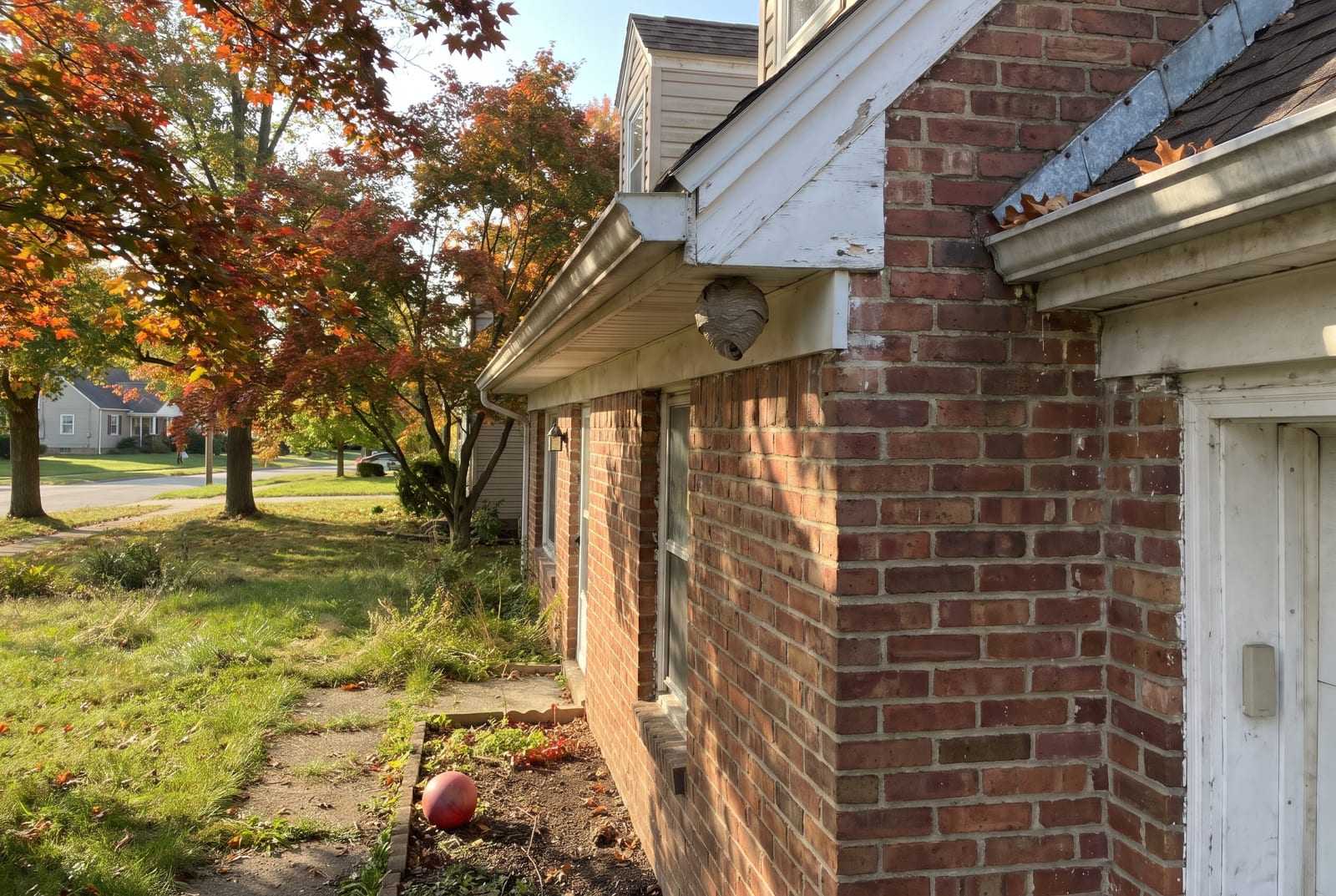
| Bald-faced hornets | Gray, football-sized or larger, one entrance near the bottom | Trees, shrubs and overhangs, often well off the ground | Late summer and early fall |
| Mud daubers | Tubes or lumps of dried mud, no paper | Sheltered walls, shed and garage ceilings, attics | Summer |
| Honey bees | Wax comb, never paper; a swarm first hangs as a cluster | Hollow trees, wall voids, chimneys | Swarms in late spring; colonies last all year |
Two of these names mislead. The bald-faced hornet is really a yellow jacket, black and white rather than black and yellow, and it defends its nest hard. Ohio’s true hornet is the European hornet, a large brown and yellow insect that nests in hollow trees and wall voids and flies to porch lights at night. Mud daubers rarely sting; they hunt spiders, and their empty mud nests can be scraped off.
Honey bees are a separate case. A swarm hanging from a branch in spring, or bees streaming in and out of a wall or chimney, calls for a local beekeeper, who can collect the swarm or move the colony. Honey bees are not killed.
Why is a nest so much bigger in late summer than in spring?
Every paper nest starts in spring with a single queen that spent the winter in a sheltered spot. She builds a few cells and raises the first workers herself; from late spring on, they take over, and the colony grows all summer.
Late in the season the colony raises new queens, natural food runs short, and workers turn to trash cans, sweet drinks and picnic food, which is when stings pick up. The first hard frost kills the workers, and the old nest is not reused; only the new queens survive the winter. An early-summer nest is small and easier to remove, while a September nest is at full strength.
Nest Hotspots on Older Youngstown Houses

Older homes give wasps more places to build. Wood soffits shrink and split, deep front porches stay dry and shaded, and decades of paint leave cracks in posts, railings and window trim. Paper wasps tuck small combs into exactly those cracks, and yellow jackets find the gaps that lead into a soffit or the wall behind it.
A nest you can see is usually less trouble than one you cannot. A gray paper nest under an eave is easy to watch and easy to reach. A steady line of yellow jackets disappearing into a gap in the siding or a hole in the lawn means a hidden colony that may be the size of a basketball inside the wall or the ground.
| Spot | Why nests form there | Risk level |
|---|---|---|
| Eaves and soffits of older homes | Shrunken or rotted boards open gaps into the roof edge, and the overhang keeps rain off | High inside the soffit; moderate when the nest hangs outside |
| Porch ceilings | Deep porches stay dry and shaded, and beadboard leaves gaps between boards | Moderate, but close to doors and people |
| Sheds and garages | Quiet rafters, gaps under siding and doors left shut for weeks | Moderate; high when a door opens into an active nest |
| Ground and wall voids | Old rodent burrows, loose foundation mortar, holes around pipes and siding | High: large hidden colonies that are easy to disturb |
When Nest Removal Belongs to a Professional
Not every nest has to go. A small paper wasp nest on a far corner of a garage, away from doors and play areas, can often be left alone. Paper wasps eat caterpillars and other garden pests and rarely sting unless the nest is touched, and the colony dies off with the first hard frost.
Leave removal to a professional when the nest is inside a wall, a soffit or the ground, when it belongs to yellow jackets or bald-faced hornets, when reaching it means a ladder, or when anyone in the household is allergic to stings. A nest in a wall void needs particular care: block the entrance and the trapped colony chews its way out, often through drywall or plaster into a room.
Safety Before You Go Near a Nest
- Keep your distance. Stay well back, and keep mowers, trimmers and leaf blowers away; vibration sets off ground nests.
- Keep children and pets inside. Especially when the nest is near a door, a play area or the lawn.
- Do not block a wall-void opening. Leave the entrance hole open, even with insects going in and out.
- Note the nest location. Which side of the house, how high, and where the entrance hole is.
- Work at dusk only if advised. The colony is calmer and inside after dark, which also means every insect is home.
When does a sting need emergency care?
Call 911 right away if someone who was stung has trouble breathing, swelling of the face, lips or throat, dizziness or fainting, or hives spreading far from the sting. These are signs of a severe allergic reaction, and they can start within minutes. If the person carries a prescribed epinephrine auto-injector, it should be used as directed while help is on the way.
For an ordinary sting, move away from the nest first, since disturbed yellow jackets and hornets keep stinging. Scrape out a honey bee stinger with a fingernail or card, wash the area with soap and water, and use a cold pack for swelling. Many stings at once, or a sting in the mouth or throat, call for medical advice even without a known allergy.